
When buyers ask for a TIVA set, the first question is often: “Do you have a 2-way, 3-way or 4-way set?”
That is a useful starting point—but it is not enough to define a safe, practical and market-ready configuration.
A TIVA administration set is part of a complete infusion system. Its suitability depends on the intended clinical workflow, the number and position of infusion lines, valve arrangement, common dead space, tubing dimensions, material selection, pump compatibility, connection security and the regulatory requirements of the destination market.
This guide explains the specification questions that distributors, hospitals and medical-device partners should clarify before selecting or developing a TIVA set. BQ+ is also inviting international partners to share their real market requirements as we evaluate an expanded TIVA set platform.
Why a dedicated TIVA set needs a complete specification
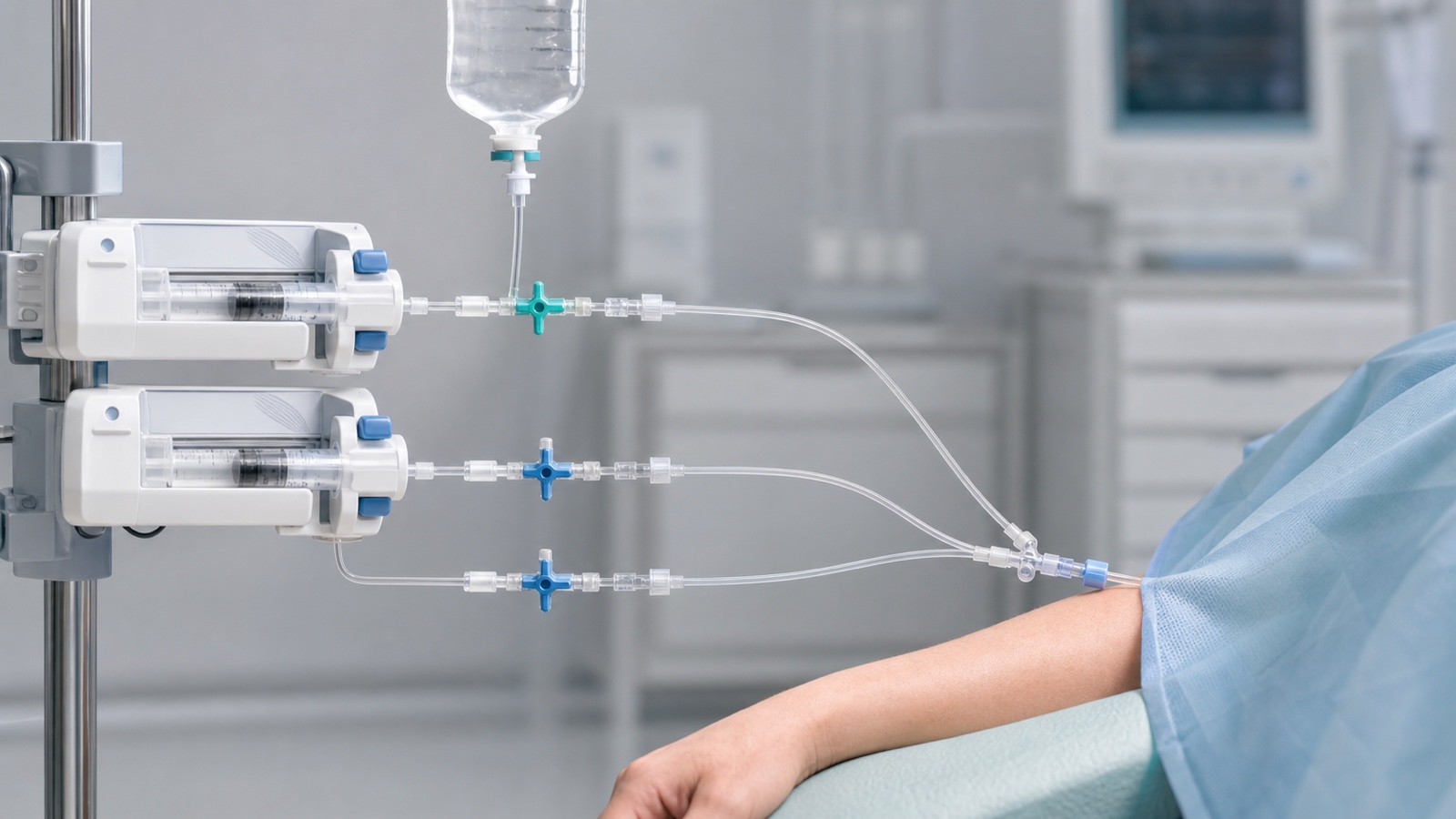
In total intravenous anaesthesia, several fluids or medicines may be delivered through one connected system. The design therefore needs to be considered as a system, not simply as several tubes joined together.
Published professional guidance cited by established manufacturers recommends the use of a dedicated TIVA administration set and highlights design considerations such as secure Luer-lock connections, anti-siphon protection on drug lines, anti-reflux protection on the fluid line and minimising the common dead space close to the patient.
For a buyer, this creates five practical questions:
- How many infusion lines are required in the actual workflow?
- Which lines require anti-siphon or anti-reflux protection?
- How close can the common connection be positioned to the patient?
- What tubing dimensions and materials suit the medicines and equipment used?
- What evidence is required before the configuration can be registered and accepted?
Comparing 2-way, 3-way and 4-way TIVA set concepts
The terms “2-way”, “3-way” and “4-way” are not, by themselves, a complete technical specification. Port counting and line functions can differ between suppliers. Every request should therefore include a drawing, labelled sample or line-by-line description.
| Configuration concept | Possible use case | Questions the buyer should answer | Main trade-off to assess |
|---|---|---|---|
| 2-way TIVA set | A comparatively simple arrangement with one drug line and one fluid or carrier line | Which line connects to the pump? Which valves are required? Where is the patient-end junction? | Fewer lines and simpler setup, but limited flexibility if another infusion is needed |
| 3-way TIVA set | A workflow requiring two drug lines plus a fluid or carrier line, or another defined three-line arrangement | Are both drug lines pump-driven? Does each require an anti-siphon valve? Are the line lengths identical? | More flexibility, with additional priming, labelling and connection-management considerations |
| 4-way TIVA set | A more complex protocol requiring multiple drug lines and a fluid or carrier line | Is every line clinically required? How will line identification, routing and occlusion risk be controlled? | Greater connectivity, but additional complexity, volume and setup risk must be evaluated |
The correct choice is not automatically the configuration with the most lines. It is the simplest validated configuration that supports the intended workflow.
Seven questions to define before requesting a quotation
1. What is the actual line-by-line clinical workflow?
Avoid specifying only “2-way” or “3-way”. Identify whether every line is a drug or carrier line, pump-driven or gravity-fed, primary or optional, and where it connects. A marked-up drawing or reference sample is usually more reliable than a product name alone.
2. What tubing lengths and layout are required?
Define the total length and each branch length, internal and external dimensions, patient-end layout, clamps or line identification, and kink-resistance expectations. Length changes can also affect priming volume, flow behaviour, packaging and handling.
3. Which pump brands and models will be used?
“Compatible with an infusion pump” is too broad. Identify the pump manufacturer, model, administration method and any relevant disposable-set interface. Pump alarm settings are not the same as validated working-pressure or burst-pressure specifications; these parameters must be defined separately with their units and test methods.
4. How is priming volume defined?
Ask for the measurement boundary points, whether the value applies per branch or to the complete set, the test liquid and method, and the acceptable tolerance. The relevant clinical issue is often the common dead space between the point where infusions meet and the patient, not only the headline volume of the complete set.
5. What valve and connector functions are required?
Depending on the intended design and risk assessment, a specification may consider anti-siphon valves on pump-driven drug lines, an anti-reflux or back-check valve on the fluid line, secure Luer-lock connections, caps, clamps, line differentiation, valve opening pressure, and leakage, backflow, free-flow and connection-integrity testing.
6. What material and drug-compatibility requirements apply?
Buyers may request PVC, PVC-free, DEHP-free or low-sorbing fluid paths, but these terms are not interchangeable. The final selection should consider the drugs and contact duration, adsorption or absorption concerns, plasticiser requirements, transparency, kink resistance, sterilisation compatibility, biocompatibility, chemical characterisation and local labelling requirements.
7. What validation and registration evidence will the market require?
Confirm the destination market, classification and registration route, applicable standards, required performance, packaging and shelf-life evidence, sterilisation expectations, label and IFU languages, and sample-evaluation or change-control requirements before the quotation is finalised.
What BQ+ is evaluating
BQ+ designs and manufactures infusion and extension solutions for international medical-device partners. Based on requests from different markets, we are evaluating an expanded TIVA set platform that may include different line counts, lengths, valve arrangements, fluid-path materials and customer-specific configurations.
This is a structured development and market-validation process. Exact configurations, performance claims and market availability will depend on confirmed user requirements, design outputs, verification and validation, and applicable registration requirements.
Frequently asked questions
What is a TIVA set?
A TIVA set is an administration-set configuration intended to support total intravenous anaesthesia workflows. Its design may combine pump-driven drug lines and a fluid or carrier line with specified valves, connectors and a patient-end junction. The exact configuration must be defined for the intended use.
What is the difference between a 2-way, 3-way and 4-way TIVA set?
The number usually refers to the number of connected lines or pathways, but naming conventions can vary. Buyers should confirm each line’s function, length, valve arrangement and connection point with a drawing or labelled sample.
Is lower priming volume always better?
Not by itself. Priming volume should be assessed together with the defined measurement boundary, tubing length and diameter, flow performance, kink resistance and the common dead space near the patient.
Can a pump’s alarm-pressure setting be used as the pressure rating of the TIVA set?
No. A pump alarm setting, a set’s intended working-pressure range and its burst-pressure evidence are different parameters. Each should be specified with units, test conditions and acceptance criteria.
Does BQ+ currently offer a complete 2-way, 3-way and 4-way TIVA range?
BQ+ is evaluating and developing configurations based on confirmed market requirements. Availability depends on the final specification, design verification and validation, and the registration requirements of the destination market. Please contact us with your required configuration for a project review.