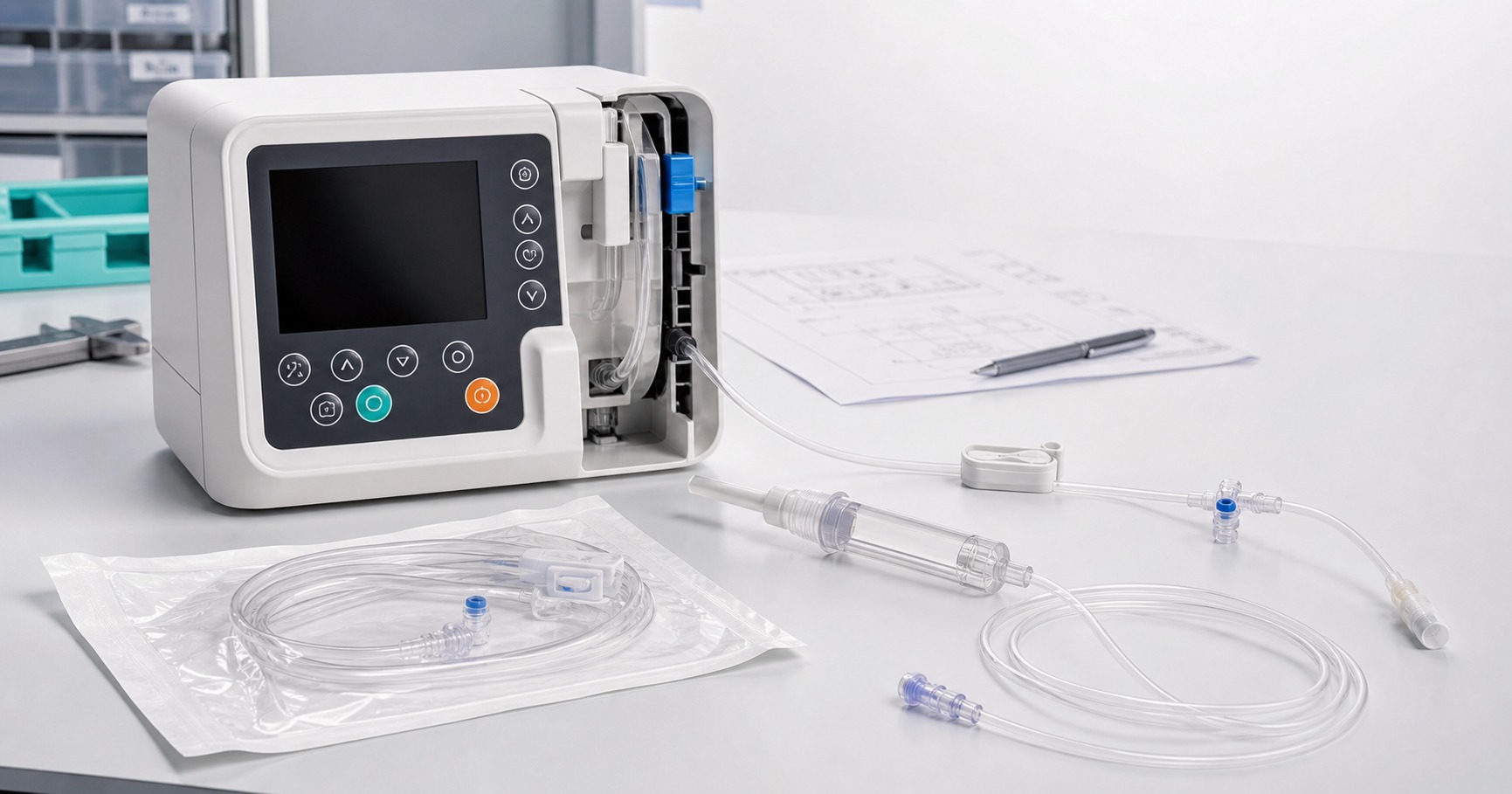
Illustration created with AI for concept visualization. Product configuration shown is for reference only.
For an infusion pump manufacturer, the consumable set is not just an accessory.
It is part of the user experience, the fluid path, the performance expectation and the long-term supply model. A pump may have strong software, control logic and industrial design, but the project can still slow down if the dedicated tubing set is not defined early enough.
BQ Plus Medical has supported dedicated consumable projects for infusion-pump manufacturers and pump-related platforms. In these projects, the discussion usually goes beyond a standard tubing set. The customer needs a disposable set that can fit the pump interface, support the intended fluid-path design, match packaging and sterilization requirements, and remain stable for repeat supply.
That is why custom consumables for infusion pumps should be discussed as an engineering and supply-chain project, not only as a price inquiry.
Why pump consumables need early definition
Many pump-related consumable projects begin with a simple request:
“Can you make a tubing set for our pump?”
This is enough to start a conversation, but it is not enough to prepare reliable samples.
The manufacturer needs to understand how the tubing set will interface with the pump, where the pump segment sits, what connectors are required, whether the set is sterile or non-sterile, how it will be packaged and which performance expectations must be reviewed.
Small differences in tubing material, wall thickness, length, clamp position, connector choice or packaging method can affect assembly, usability, testing, lead time and cost.
From our experience, the most productive projects are not the ones that begin with a perfect specification. They are the ones where the pump manufacturer and consumable supplier quickly identify what is already fixed, what still needs testing, and which details may affect pump fit, user handling, production repeatability and long-term supply.
1. Define the pump interface first
The most important question is how the consumable set fits into the pump platform.
The RFQ or project brief should clarify:
- pump model or platform;
- pump mechanism, if shareable;
- pump segment length and position;
- tubing inner diameter and outer diameter;
- required tubing elasticity, transparency and hardness;
- loading direction and user handling requirements;
- any cassette, clip, holder or anti-free-flow feature.
If the pump interface is still under development, mark it as an open design item. This helps both teams separate confirmed requirements from assumptions.
2. Treat the pump segment as a critical area
For many infusion pump sets, the pump segment is where technical discussion becomes most important.
The pump manufacturer may need to review:
- dimensional stability;
- wall thickness tolerance;
- elasticity and recovery behavior;
- flow performance under the intended pump conditions;
- kinking, compression and set fatigue risk;
- compatibility with the planned assembly and packaging process.
The tubing-set supplier should not guess the performance target from a photo. A clearer pump-segment requirement helps the supplier prepare more relevant samples and identify potential process questions earlier.
3. Clarify the full fluid-path configuration
A pump set may include much more than tubing.
Depending on the application, the configuration may include:
- spike or container connection;
- drip chamber;
- roller clamp or slide clamp;
- injection site;
- needle-free connector;
- check valve;
- filter;
- flow regulator;
- luer connector;
- stopcock;
- protective cap;
- extension line or branching structure.
Each component should be defined by function, interface and responsibility. If the pump manufacturer wants to supply a key component, the project should also define incoming inspection, traceability, storage, yield loss and responsibility for component-related issues.
4. Separate prototype samples from validated production samples
Early handmade samples can be useful for concept review, but they should not be confused with routine production samples.
A practical sample plan may include:
- initial layout samples for configuration review;
- pump-fit samples for loading and user handling;
- functional samples for flow and connection review;
- pilot samples from intended production tooling;
- validation or customer-integration samples;
- commercial production lots.
This staged approach helps the pump manufacturer and consumable supplier avoid treating an early prototype as if it already represents the final manufacturing process.
5. Confirm packaging, sterilization and labeling early
Packaging and sterilization can influence material selection, assembly process, shelf-life expectations and project timing.
The project brief should state whether the consumable will be supplied as:
- a non-sterile bulk component;
- a non-sterile assembled set;
- an individually packed non-sterile product;
- a sterile, packaged product.
For sterile supply, the team should discuss packaging concept, sterilization method, shelf-life expectation and release-document requirements before the final sample plan is locked.
Labeling should also be clarified early, including brand owner, private label, language, barcode, UDI or carton-label requirements where applicable.
6. Align documentation and change control
Dedicated consumables often become part of a pump manufacturer’s controlled system.
Before routine supply begins, both sides should understand:
- who owns the finished-device registration or market authorization;
- which specifications are controlled by the pump manufacturer;
- which process controls are managed by the consumable supplier;
- what test records, material information or release documents are required;
- how design, material, supplier or process changes will be reviewed and communicated.
A certificate or regulatory status associated with one product or configuration should not be assumed to cover a different pump-specific consumable. Scope should be confirmed project by project.
7. Build the project around reliable supply, not only first samples
For pump manufacturers, the first successful sample is only the beginning.
Long-term supply also depends on:
- stable material sourcing;
- controlled component selection;
- repeatable assembly;
- inspection and release discipline;
- realistic lead times;
- forecast communication;
- clear response when technical or quality questions arise.
This is where a consumable supplier needs more than basic production capacity. The supplier needs cross-functional coordination between sales, engineering, quality, production, supply chain and delivery.
What we have learned from pump-manufacturer projects
Dedicated consumable projects for pump manufacturers are different from ordinary catalog-product sourcing.
In a catalog-product inquiry, the buyer may mainly compare price, certificate scope, minimum order quantity and delivery time. In a pump-specific consumable project, the discussion is more integrated. The disposable set may need to support the pump design, customer assembly process, user workflow, packaging concept, documentation package and future change-control expectations.
Several lessons are especially important:
- Do not treat the pump set as only tubing. The pump segment, connector sequence, clamp position, length control and packaging method can all affect the final user experience.
- Do not wait until late-stage validation to discuss manufacturability. If a special structure is difficult to assemble repeatably, the issue should be identified before the sample plan becomes too rigid.
- Do not separate price from configuration. A small change in component source, packaging, sterilization or inspection scope can change the real quotation basis.
- Do not rely on one successful sample. The project should move from layout sample to process-based sample and then to repeatable production conditions.
- Do not ignore future changes. Once the consumable is linked to a pump platform, material, tooling, component or process changes may need customer review.
For this reason, BQ prefers to discuss pump-related consumables with engineering, quality and sourcing information together. This helps both sides avoid repeated sample loops and makes the project easier to move from concept to controlled supply.
What to include in an infusion pump consumables RFQ
Before asking for quotation, prepare these points where available:
- pump model or platform;
- intended application and target market;
- drawing, sample or configuration sketch;
- tubing dimensions and material preference;
- pump segment requirements;
- connector and component list;
- sterile or non-sterile supply;
- packaging and labeling requirements;
- sample stages and expected quantities;
- required documents and test expectations;
- forecast volume and commercial timeline;
- change-control expectations.
The RFQ does not need to answer every technical question at once. It should make clear what is confirmed, what is open and which decisions must be reviewed jointly.
Planning dedicated consumables for an infusion pump platform?
BQ Plus Medical supports OEM and ODM discussions for infusion-related disposable products, custom tubing sets and dedicated consumable configurations for pump manufacturers.
Based on experience with pump-manufacturer projects, our team can help review configuration, pump-interface questions, sample stages, packaging, sterilization arrangements, quality requirements and supply-scope questions before technical evaluation.
Exact product availability, materials, performance requirements, documentation, regulatory scope, pricing and lead time are confirmed project by project.
CTA: Discuss Your Pump Consumables Project